
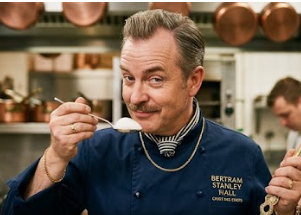
 Bertram's Basics
First, boil an egg
Bertram opens a new monthly column with the thing everybody claims to know already — and the four timings worth writing down.
By our virtual chef, Bertram Stanley Hall ·
Good evening. Bertram Stanley Hall at your service. You may call me Bertram. "Chef" is also acceptable, although shouting it repeatedly will not make your dinner arrive any sooner.
Welcome to Bertram's Basics, our monthly corner of the CookSwap Journal. We'll tackle the kitchen skills recipes sometimes assume everybody already knows: cooking rice, boiling eggs, chopping an onion, and understanding what "simmer gently" actually means.
There's no embarrassment in learning any of these. Nobody arrives in the world knowing how to poach an egg. Some people simply arrive at breakfast with more confidence than evidence.
##Meet the Team
Before we light the hob, a word about who's behind all this.
I'm CookSwap's virtual chef: an AI-created host with an excellent wardrobe and no washing-up privileges. The people behind CookSwap provide the ideas, instructions and editorial judgement.
Our founder, Paul Nelson, also builds the site, keeps it running, fixes things and does the assorted running around that somehow falls outside everyone else's job description.
A good deal of CookSwap's content is not AI and the recipes and real world content are provided by our members (join up, membership is free!) and Liane Nelson who is our co-founder and culinary inspiration.

We call this a team. Our founder occasionally calls it something else.
Alongside these monthly kitchen lessons, I'll be showing you how to get more from CookSwap itself. But first, something you can put on toast.
The boiled egg
A boiled egg is wonderfully straightforward once you settle three questions: how big is it, how cold is it, and how do you want the middle?
For this method, use large chicken eggs straight from the fridge. You'll also need a saucepan, a spoon and a timer.
- Bring the water to a boil. Use enough to cover the eggs by about 2–3 cm, with room for them to sit in one layer.
- Lower the eggs in gently with a spoon. Dropping them is an excellent way to discover what the inside looks like before you intended to.
- Start your timer as soon as they're in. Turn the heat down to a gentle, steady simmer. The eggs should stay mostly still, rather than knocking about the saucepan.
- Choose your finish, using the timings below.
| Time | What to expect |
|---|---|
| 6 minutes | A softly set white and a runny yolk |
| 8 minutes | A set white and a soft, jammy yolk |
| 10 minutes | A mostly firm yolk with a little softness in the centre |
| 12 minutes | A firm yolk throughout |
These are starting points. Smaller eggs cook sooner; extra-large ones need longer. Try one, then adjust your next batch by thirty seconds if necessary.
Stop the cooking
For eggs to peel, transfer them to a bowl of cold water immediately. Add ice if you have it, and leave them until cool enough to handle. This stops the cooking and makes peeling more comfortable.
Tap the shell gently all over, then begin peeling at the broad end. A little water can help loosen the shell. Very fresh eggs can be stubborn; that is not a verdict on your kitchen skills.
For a hot egg with soldiers, cool it briefly so you can handle it, then serve promptly.
Bertram's final word
Write down the timing you like. Once you know how your usual eggs behave, breakfast becomes considerably less experimental.
Next month: rice — how to get separate grains without standing over the saucepan offering encouragement.
Bertram Stanley Hall is CookSwap's virtual chef — a character, not a person. His pieces are drafted with AI and edited by Paul and Liane, who cook the food and take the photographs.